
When a Colored Stainless Weld Is a Warning—and When It Is Not
Color alone does not decide acceptance; oxidation severity, intended service, and governing requirements determine whether to accept, clean, or rework.
By Cole Brandt, CWI-certified welder Updated September 4, 2026
This article provides general inspection and fabrication guidance. The applicable code, drawing, qualified welding procedure, owner specification, equipment manual, safety procedure, and purchaser acceptance criteria control the work.
The short answer: heat tint is not automatically a weld defect
Visible heat tint on stainless steel is not universally or automatically a code-defined weld defect. The reviewed technical guidance treats acceptability as dependent on oxidation severity, service conditions, and the governing specification rather than establishing one universal rule (guidance on stainless-steel weld color and acceptance).
Gold, straw, brown, purple, blue, gray, or black discoloration shows that the hot stainless surface encountered oxygen and oxidized. That makes color an important inspection clue, but it does not answer every question about the joint.
Depending on the project, heat tint may be:
- acceptable as documented;
- an unacceptable surface condition that must be cleaned;
- a contractual nonconformance requiring purchaser approval;
- evidence of poor shielding or purge control that warrants further evaluation; or
- part of severe oxidation that justifies weld removal and rework.
The inspector must separate three judgments:
- Weld integrity: Does the joint have cracks, porosity, lack of fusion, inadequate penetration, undercut, unacceptable profile, incorrect dimensions, or another prohibited discontinuity?
- Surface and corrosion condition: Has oxidation left a surface that may perform poorly in the intended environment?
- Document compliance: Does the weld satisfy the code, drawing, owner specification, finish requirement, qualified procedure, inspection plan, and purchaser acceptance criteria?
Heat tint alone does not prove cracking, porosity, lack of fusion, inadequate penetration, or insufficient mechanical strength. It is primarily evidence of a surface-oxidation condition, not a complete assessment of weld quality.
The reverse is equally important: a bright silver or lightly tinted weld does not prove acceptable fusion, penetration, bead profile, dimensions, or mechanical properties. A clean-looking weld can contain an unrelated discontinuity.
A weld can therefore be structurally sound yet unacceptable for corrosion resistance, cleanliness, appearance, or contractual reasons. It can also look excellent while failing another weld-quality requirement.
Practical rule: Do not accept or reject heat tint on stainless by color alone. Identify the governing requirement and intended service first, and then evaluate weld integrity and surface condition separately.
What heat tint is and why stainless steel forms it
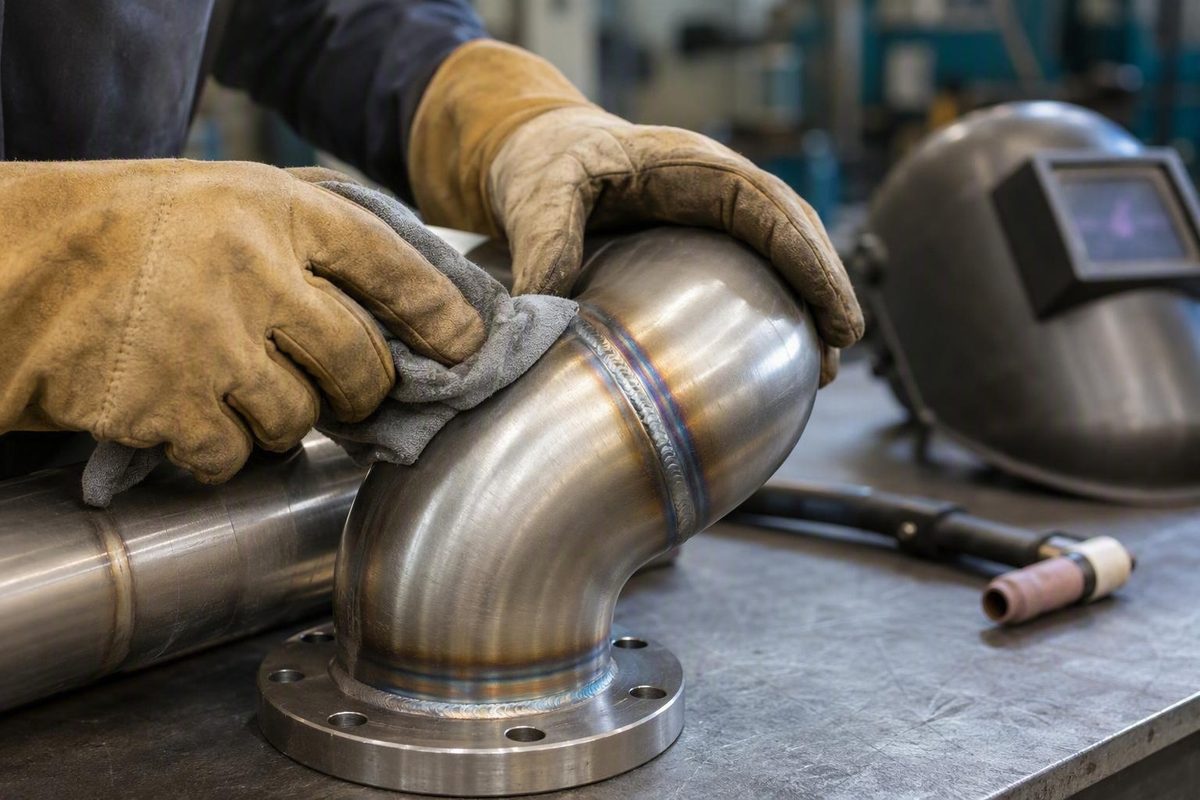
Heat tint is high-temperature oxidation on the weld metal and adjacent heat-affected zone, or HAZ. It forms when the hot surface is exposed to enough oxygen during or after welding. Common appearances include pale yellow or straw, gold, brown, purple, blue, gray, and black.
Stainless steel obtains much of its corrosion resistance from a thin, passive chromium-bearing oxide film. Welding changes the local surface condition. TWI explains that welding oxidation can produce a relatively unprotective chromium-rich scale while leaving a chromium-depleted surface immediately beneath it, potentially impairing corrosion resistance (TWI’s explanation of stainless weld heat tint).
They are not separate dyes or deposited pigments. Their appearance varies with oxide development and the conditions under which the oxide formed.
Heat tint is a surface phenomenon. It is not the same as rust, and its presence does not by itself prove internal material damage. It does show that the stainless surface experienced oxidation while hot.
Ordinary heat tint must also be distinguished from sugaring. Sugaring is rough, dull, granular, or crusted backside oxidation, often dark gray or black. It is commonly associated with inadequate root shielding or back purging in full-penetration stainless joints. Its roughness and severity make it more consequential than a smooth, lightly tinted surface, particularly in sanitary service (Miller’s discussion of heat tint and root sugaring).
That distinction does not create a universal rejection rule. It does change the inspection questions:
- Is the condition smooth heat tint or rough oxide scale?
- Is it on the accessible face or an enclosed root?
- Was the root effectively shielded?
- Can the affected surface be cleaned and verified?
- Would cleaning alter wall thickness, dimensions, or finish?
- Does the controlling document limit the condition?
Why heat tint can be more than a cosmetic issue
The principal technical concern with heat tint is usually corrosion performance, not an automatic reduction in weld strength.
A stainless surface needs enough available chromium to establish and maintain a protective passive film. Heat-tint oxide and the chromium-depleted surface beneath it can weaken that protection. In a mild environment, the difference may never become operationally important. In chloride-bearing, wet, chemically aggressive, creviced, or difficult-to-clean service, it can matter substantially.
TWI says the critical pitting temperature may be reduced from 60°C to 40°C for a type 316 stainless-steel weld in 0.1% NaCl solution with an applied potential of +300 mV SCE Avoiding heat-tint during welding of stainless steels - TWI.
That 20°C difference must not be treated as a universal heat-tint penalty. It applies to the stated alloy, solution, applied potential, specimen condition, and test method. It does not mean every tinted 304, 316, duplex, ferritic, or highly alloyed stainless weld suffers the same reduction—or that a component will fail at either temperature in actual service.
The broader conclusion is more useful than the isolated number: heat tint can measurably reduce localized-corrosion resistance under some conditions.
The concern generally becomes more important when the weld will encounter:
- standing or continuously present moisture;
- seawater, deicing salts, brines, or other chloride sources;
- acidic, alkaline, or process chemicals;
- deposits, lap joints, gaskets, or other crevice-forming geometry;
- product contact and frequent cleaning;
- high-purity service where particles or contamination matter;
- inaccessible surfaces that cannot be inspected or maintained readily.
Dry indoor service may impose little corrosion demand, whereas a similarly colored weld inside process tubing may face continuous exposure and difficult cleaning. The same visible condition can therefore receive different dispositions without contradiction.
Peer-reviewed research supports the broader corrosion concern. A Journal of Laser Applications study evaluated heat-tint removal using surface morphology, roughness, and pitting-corrosion testing. It reported that heat tint adversely affected corrosion performance and that tested laser treatments improved pitting resistance (research on laser-assisted heat-tint removal). That finding supports treating tint as a potentially important surface condition; it does not classify every tinted weld as defective under every fabrication standard.
What weld color can—and cannot—tell you
Color is a useful qualitative warning sign of oxide development. It is not a universal pass-fail chart.
In general, darker purple-blue, gray, or black discoloration indicates heavier oxidation and greater corrosion concern than a silver surface or light straw tint. TWI describes purple-blue oxides as generally among the most susceptible to corrosion attack. That technical observation is not, by itself, a code acceptance threshold.
Appearance is influenced by:
- stainless grade and alloy composition;
- oxygen availability;
- time at elevated temperature;
- shielding and trailing-shield effectiveness;
- travel speed and heat input;
- repeated heating from adjacent passes;
- original surface finish and roughness;
- surface contamination;
- lighting, camera settings, viewing angle, and human color perception.
Commercial heat-tint charts can help with process control or comparison against agreed samples. A chart does not become a code requirement merely because it carries an industry label. Some published charts refer generally to industry authorities without identifying the precise editions or clauses behind their categories, limiting their value as stand-alone acceptance evidence (Huntingdon Fusion’s description of heat-tint charts).
Qualitative color guide
| Visible condition | Qualitative interpretation | Appropriate response |
|---|---|---|
| Silver or pale straw | Relatively limited visible oxidation | Check the governing requirement and inspect every other weld attribute |
| Brown or purple | More developed oxidation | Review service severity, shielding or purge performance, and cleaning requirements |
| Blue, gray, or black | Heavier oxidation and greater corrosion concern | Verify acceptance criteria; cleaning, evaluation, or rework becomes more likely |
| Rough, granular, or crusted root | Possible severe backside oxidation or sugaring | Assess purge failure, cleanability, corrosion exposure, and the possible need for weld removal |
This guide is intentionally qualitative. It must not replace a project-specific acceptance criterion.
If color forms part of acceptance, document it consistently:
- use controlled lighting and repeatable camera settings;
- include a scale and weld identification;
- identify whether the image shows the face, root, or adjacent HAZ;
- record the alloy and original surface finish;
- photograph an agreed reference coupon beside the weld where practical;
- cite the governing document, revision, clause, or approved visual standard.
“Looks too blue” is not a durable inspection record. “Root surface exceeds purchaser-approved coupon B under the lighting and inspection method specified in document X” is.
When heat tint is likely to be accepted, cleaned, or rejected
The correct disposition changes with service, surface location, accessibility, and contract requirements. Commercial fabrication guidance similarly distinguishes surface discoloration in mild service from conditions in food, chemical, or marine applications where corrosion and cleanability become more important (application-dependent guidance on stainless discoloration).
A tinted external weld that can be cleaned and inspected readily is not equivalent to the same condition inside small-bore product-contact tubing. Food-grade guidance also treats root sugaring and visible oxidation more seriously where smoothness, corrosion resistance, and cleanability are required (food-grade stainless welding guidance).
| Service context | Primary concern | Likely disposition | Documents to verify |
|---|---|---|---|
| Dry indoor or low-corrosion general fabrication | Appearance and workmanship | Limited tint may be accepted if permitted and all other criteria pass | Drawing, fabrication specification, visual criteria, purchaser requirements |
| Architectural or exposed cosmetic work | Appearance consistency and staining | Clean, refinish, or reject according to the specified finish, even if structurally sound | Finish schedule, sample panel, drawing notes, approved reference |
| Outdoor or continuously wet service | Reduced corrosion margin | Cleaning or engineering evaluation becomes more important | Material specification, finish requirements, owner corrosion criteria |
| Marine or chloride-bearing service | Pitting and crevice corrosion | Oxide removal and verification are more likely; severe root oxidation may require rework | Service specification, owner requirements, inspection plan |
| Chemical or process piping | Chemical compatibility, root condition, crevices, and access | Evaluate the face and root separately; clean and verify where required | Piping specification, line class, weld procedure, owner criteria |
| Food and beverage product-contact surfaces | Corrosion resistance, cleanability, finish, and residue retention | Usually requires stricter review; remove tint where the applicable requirement demands it | Applicable sanitary standard and edition, drawings, finish criteria |
| Pharmaceutical, medical, semiconductor, or high-purity service | Cleanability, contamination control, particles, and surface consistency | Cleaning and verification are frequently required; deviations may need owner approval | Project standard, approved procedure, finish criteria, validation documents |
| Non-product-contact sanitary equipment | Corrosion and cleaning exposure may be lower | May receive a different disposition from product-contact areas | Equipment-zone classification, owner specification, weld location |
Do not assume that every sanitary standard prohibits every trace of visible tint. Verify the exact standard, edition, clause, drawing note, owner specification, weld location, and approved acceptance method. Vendor summaries can identify possible concerns, but they do not replace the controlling document.
Appearance requirements alone can make tint contractually unacceptable even when corrosion risk is modest. A buyer may have purchased a uniform brushed finish, a polished architectural surface, or welds matching an approved sample. Failure to provide that finish is a genuine nonconformance even if no crack, pore, or fusion defect exists.
Three bounded examples show how disposition can differ:
- Lightly tinted dry-service bracket: It may be accepted if the drawing and purchaser criteria permit the surface, dimensions are correct, and the weld passes all required examinations.
- Blue-purple root in process pipe: It warrants review of purge performance, service chemistry, cleanability, and the governing specification. Cleaning, post-cleaning verification, or engineering approval may be appropriate.
- Rough black root oxidation: Treat it as possible sugaring rather than merely a color issue. Assess roughness, accessibility, contamination risk, and whether cleaning would remove excessive material. Weld removal and rework may be necessary.
A practical inspection and disposition workflow
Use a documented decision process instead of an informal color preference.
-
Identify the controlling documents. Begin with the governing construction code, drawing, owner specification, qualified welding procedure, finish requirement, inspection plan, and purchaser acceptance criteria. Confirm the applicable revisions and clauses. Do not substitute a generic internet color chart.
-
Define the component and service. Record the stainless grade, component function, expected fluid or atmosphere, wet or dry exposure, chloride or chemical exposure, operating temperature, cleaning regime, product-contact status, and consequences of localized corrosion.
-
Locate the condition precisely. State whether tint is on the weld face, toe, adjacent HAZ, root, internal bore, crevice, or inaccessible enclosed surface. Accessibility affects both risk and available corrective actions.
-
Inspect both sides where possible. Use the examination method authorized for the component rather than assuming that face appearance represents root condition.
-
Separate tint from weld integrity. Evaluate heat tint independently from cracks, porosity, undercut, overlap, profile, dimensions, arc strikes, penetration, and fusion. Perform required visual, surface, volumetric, leak, or pressure examinations separately.
-
Assess oxidation severity and texture. Record color, width, continuity, roughness, loose scale, crusting, and evidence of sugaring. Texture and root condition may be more significant than hue alone.
-
Review process evidence. Check the welding procedure, shielding arrangement, gas records, purge setup, oxygen readings where required, parameter or heat-input records, interpass controls, and any approved reference coupon.
-
Choose one immediate disposition. - Accept as documented: Requirements permit the condition and every other criterion passes. - Clean: Oxide removal is required, followed by routine examination. - Clean and verify: Service or specification requires evidence of the final surface condition. - Obtain engineering or owner approval: Requirements are silent, ambiguous, or exceeded without a prescribed repair. - Remove and rework: Oxidation is severe, cleaning cannot produce the required surface, or a separate weld discontinuity requires repair.
-
Verify the final result. Perform the specified visual examination and any required cleanliness, roughness, contamination, nondestructive, leak, or corrosion-related check.
Cleaning may correct an oxidized surface. It cannot repair a crack, lack of fusion, inadequate penetration, unacceptable dimensions, or deficient bead geometry. A bright post-cleaning finish must not conceal the need for a separate weld-quality assessment.
If the governing requirements are silent, do not invent a threshold such as “straw passes, blue fails.” Obtain a written disposition from the responsible owner, engineer, purchaser, or quality authority.
A useful inspection record includes:
- component and weld identification;
- stainless grade and product form;
- welding process and procedure;
- face or root location;
- service and product-contact classification;
- photographs and reference coupon, if used;
- purge record or oxygen reading, if available;
- controlling document, revision, and clause;
- original disposition;
- cleaning or repair method;
- post-treatment examination results;
- final approval and responsible authority.
How to prevent excessive heat tint during welding
Prevention centers on limiting oxygen exposure while the weld metal and HAZ remain hot.
Torch-side shielding
Use the shielding arrangement required by the qualified procedure. Confirm the specified gas, flow setting, cup or gas-lens arrangement, torch position, arc length, and protection from drafts.
A trailing shield may be needed where the hot weld remains exposed beyond the torch’s shielding envelope. Whether it is required depends on the procedure, process, geometry, alloy, and travel conditions.
Do not change gas flow, cup configuration, or torch technique merely to produce a preferred color if the change could compromise fusion, penetration, or procedure compliance.
Root shielding and back purging
Tube, pipe, and other full-penetration joints often need root-side protection. The purge arrangement should displace air at the actual weld zone and remain effective for the procedure-specified period.
TWI recommends pure argon as a backing gas and notes that argon-nitrogen mixtures can work for some highly alloyed stainless steels. Gas selection must still follow the qualified procedure and material requirements rather than being treated as universal.
Control purge oxygen to the qualified procedure or project requirement. No single parts-per-million limit applies universally to every alloy, process, thickness, root geometry, and service.
Heat input and technique
Excessive heat input, slow travel, long arcs, repeated heating, poor torch position, and unnecessary dwell can widen or darken oxidation. Balance penetration and fusion requirements against the need to limit time at elevated temperature.
A narrow, pale weld that lacks fusion is not an improvement over a sound weld that requires an approved post-weld treatment.
Plan tack placement, travel, starts, stops, and interpass sequence before welding. On multipass work, account for reheating of previously welded areas and maintain shielding as required by the procedure.
Cleanliness and tooling
Clean the joint and adjacent surfaces as required by the procedure. Oils, marking compounds, adhesive residue, embedded iron, and dirty abrasives can complicate the final surface condition.
Use tools dedicated to stainless steel. Carbon-steel wire brushes and shared abrasives can transfer free iron, later producing rust staining and confusing the diagnosis. Store dedicated brushes and discs so they cannot be mixed with carbon-steel tools.
Pre-weld checklist
- Confirm the correct WPS and stainless grade.
- Verify shielding and purge gas identity.
- Check cylinders, hoses, fittings, regulators, and flow devices.
- Leak-test the purge arrangement where required.
- Provide adequate purge volume, distribution, and venting.
- Confirm oxygen-monitor calibration and target when monitoring is specified.
- Select the required cup, lens, diffuser, or trailing shield.
- Protect the welding area from drafts.
- Confirm fit-up, root gap, purge dams, and tack condition.
- Plan travel, starts, stops, and interpass sequence.
- Clean the joint with approved materials.
- Use dedicated stainless brushes and uncontaminated abrasives.
- Maintain shielding and purge for the procedure-specified period.
How heat tint is removed—and why passivation alone may not be enough
When optimum corrosion resistance is required, the objective is not simply to erase the visible color. Treatment should address both the oxide scale and the chromium-depleted surface beneath it.
Different processes can produce similarly bright-looking surfaces while removing different amounts of affected material. Method selection should therefore be based on the required outcome: cosmetic blending, scale removal, removal of the affected surface, controlled roughness, high-purity finish, or preparation for passivation.
| Method | Expected role | Limits and qualifications | Verification focus |
|---|---|---|---|
| Fine mechanical finishing | Removes oxide and can remove affected surface material when enough material is taken uniformly | Best suited to accessible surfaces; execution determines removal depth and final profile | Dimensions, wall thickness, uniformity, finish, and tool contamination |
| Chemical pickling | Removes oxide scale and can remove the chromium-depleted surface | Chemical access and complete rinsing matter; the chemicals present severe hazards | Complete treatment, rinse condition, residue control, and final appearance |
| Electrochemical cleaning | Can remove accessible weld discoloration under a qualified process | Results depend on equipment, chemistry, severity, geometry, and procedure (electrochemical cleaning guidance) | Complete oxide removal, residue control, and consistency |
| Electropolishing | Removes surface material and can improve finish | Suitability depends on component design, process control, alloy, and required finish (electropolishing guidance) | Material removal, dimensions, surface finish, and coverage |
| Laser cleaning | Can remove heat tint under qualified parameters | Research findings apply to tested pulse conditions; results depend on alloy, energy settings, geometry, and required surface condition (laser heat-tint study) | Coverage, morphology, roughness, and specified corrosion-related checks |
| Stainless wire brushing | May reduce visible tint and remove loose material | Often does not remove the chromium-depleted layer completely | Remaining oxide, contamination, finish consistency, and service suitability |
TWI states that acid pickling, preferably preceded by grinding, produced the best corrosion-resistance improvement among the methods it discusses. It also says hand brushing with a stainless brush and sandblasting are generally less effective because they usually do not remove the chromium-depleted layer (TWI’s comparison of heat-tint removal methods).
That does not make grinding and pickling the only acceptable treatment. Mechanical-finish limits, dimensional tolerances, internal geometry, alloy, production controls, environmental restrictions, and owner requirements may favor another qualified method. The selected process must achieve the specified surface condition rather than merely produce a bright appearance.
Cleaning, oxide removal, and passivation do different jobs
These terms should not be treated as interchangeable:
- Cleaning removes oils, soil, loose contamination, and process residue.
- Mechanical or chemical oxide removal removes heat-tint scale and, when performed sufficiently, the affected surface beneath it.
- Passivation supports formation of a clean passive surface after suitable preparation.
Passivation is not a universal method for removing heavy oxide. Mechanical finishing, pickling, electrochemical treatment, electropolishing, or another qualified oxide-removal operation may be needed before passivation can produce the specified result.
Nitric-hydrofluoric pickling systems are highly toxic and require appropriate safety precautions, according to TWI (TWI’s chemical-hazard warning). Use them only under a qualified workplace procedure, with trained personnel and the controls required by the applicable safety documentation. General fabrication guidance is not a substitute for the product safety data, site rules, or emergency procedures.
When cleaning is not enough
Escalate for engineering review or weld rework when:
- the root has rough, crusted, or deeply oxidized sugaring;
- oxide or contamination is inaccessible;
- cleaning would remove too much wall thickness or alter required dimensions;
- the specified surface finish cannot be restored;
- repeated cleaning is producing grooves or an unacceptable profile;
- contamination cannot be verified as removed;
- the component’s service risk exceeds the evidence available for acceptance; or
- a separate crack, fusion defect, penetration issue, or geometric nonconformance is present.
After treatment, verify the result against the applicable requirement:
- visual appearance and oxide removal;
- acceptable weld and HAZ surface condition;
- absence of prohibited cross-contamination;
- specified roughness or directional finish;
- cleanliness and rinse quality where required;
- dimensions and minimum wall thickness after material removal;
- required surface, leak, or other examination;
- documented approval and traceability.
Frequently asked questions
Is heat tint on stainless steel the same as rust?
No. Heat tint is a high-temperature oxide condition formed during welding or another thermal exposure. Rust is a corrosion product that develops through a different process.
Heat tint can nevertheless leave stainless steel more vulnerable to later corrosion because the protective surface condition has been altered. Supplier guidance likewise distinguishes heat tint from rust and describes it as a surface phenomenon rather than proof of internal damage (explanation of post-fabrication stainless discoloration).
Is light straw discoloration always acceptable on a stainless weld?
No. Light straw generally indicates less visible oxidation than blue, gray, or black tint, but it is not universally acceptable.
Acceptance depends on the governing document, service, weld location, finish requirement, and purchaser criteria. Even when light tint is permitted, the weld must still meet every separate requirement for fusion, penetration, profile, dimensions, and discontinuities.
Does blue or purple heat tint mean the weld is weak?
Not by itself. Blue or purple tint indicates oxidation and may signal increased corrosion concern, but color alone does not establish tensile strength, fusion, penetration, cracking, or porosity.
Inspect mechanical and geometric weld quality separately. In corrosion-sensitive service, evaluate or remove the tint as required even if the joint is otherwise sound.
Will passivation alone remove stainless-steel weld heat tint?
Not reliably, especially when the oxide is heavy. Passivation is not a universal substitute for removing heat-tint scale and the affected surface beneath it.
The qualified treatment sequence may require mechanical finishing, pickling, electrochemical cleaning, electropolishing, or another oxide-removal method before passivation.
What is the difference between heat tint and sugaring on the weld root?
Heat tint is generally smooth surface discoloration caused by high-temperature oxidation. Sugaring is severe backside oxidation that typically appears rough, dull, granular, or crusted and is associated with inadequate root shielding or back purging.
Because sugaring creates a rougher and more severely oxidized surface, it raises stronger concerns about corrosion, cleanability, contamination retention, and whether cleaning can restore the required condition. It may require weld removal and rework, but the final disposition still comes from the applicable specification and engineering assessment.
The final decision
Use a four-part decision before accepting or rejecting a colored stainless weld:
- Identify the condition. Determine whether it is ordinary smooth heat tint, loose oxide scale, contamination, rust staining, or severe root sugaring.
- Inspect weld integrity separately. Check fusion, penetration, cracks, porosity, dimensions, profile, and every other required weld attribute.
- Verify the exact requirements. Consult the applicable code, edition, clause, drawing, owner specification, service conditions, finish criteria, and purchaser acceptance method.
- Document the disposition. Record acceptance, cleaning, post-treatment verification, engineering approval, repair, or weld removal and rework.
Color is a valuable warning about oxygen exposure and possible corrosion performance. It is neither universal proof of a bad weld nor permission to ignore the surface in corrosion-sensitive service.