
Choose a Flux-Core Welder by Wire Compatibility and Usable Output
Choose a flux-core welder by supported wire, polarity, input power, duty cycle and feeder parts—not just the maximum amp number.
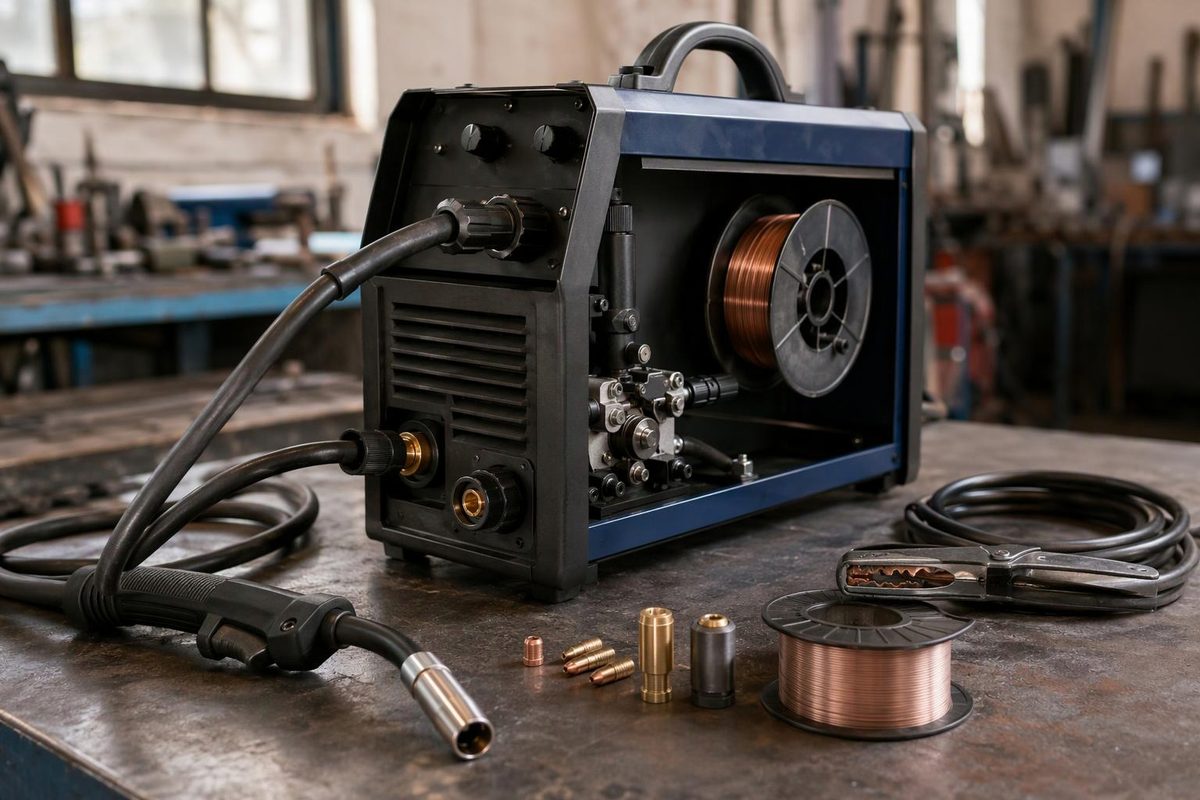
For occasional mild-steel projects, a dedicated DC self-shielded flux-core welder can be a sensible choice. If you expect to use solid-wire MIG later, investigate a MIG/FCAW machine instead. For longer welds or joints needing higher output, compare higher-duty-cycle machines and their performance on 240 V—even if you plan to run without a cylinder initially.
The deciding question is not “How many amps are on the box?” It is: Can this machine run the wire your job needs, at the required voltage and feed speed, for long enough?
Choose the right kind of flux-core machine
A gasless machine needs to support self-shielded flux-cored wire, or FCAW-S. Gas-shielded flux-core, FCAW-G, uses a different consumable and requires external shielding gas. A “flux-core” label alone does not establish which process the package supports. Lincoln Electric explains the two equipment arrangements.
| Your intended work | Machine type to investigate | Main buying check |
|---|---|---|
| Occasional mild-steel projects, no plans for shielding gas | Dedicated self-shielded DC wire welder | Supported wire, low-end settings and duty cycle |
| Gasless work now, solid-wire MIG later | MIG/FCAW machine | Polarity-change provision and gas hardware |
| Longer welds or joints needing higher output | Higher-duty-cycle 240 V or dual-voltage MIG/FCAW machine | Output rating at the required welding current |
| Heavy fabrication with larger cored wire | CV power source and compatible feeder, or an appropriately rated integrated unit | Full wire operating range, gun rating and procedure requirements |
For conventional wire welding, constant-voltage output works with a constant-speed feeder to stabilize arc length. A basic stick-only constant-current machine is not a straightforward substitute. Some specialized feeders can operate from CC sources, but that is not the simple beginner route. Lincoln’s CC/CV explanation covers that distinction.
Compare rated output, not the model number
These two machines illustrate different buying categories, not a tested ranking. Manufacturer specifications checked November 3, 2026:
| Example | Input | Published rated output | Practical distinction |
|---|---|---|---|
| TITANIUM Easy-Flux 125, item 57861 | 120 V | 90 A at 30% duty cycle | Dedicated flux-core unit; 15 lb.; 4-inch spools |
| Miller Millermatic 211 PRO, stock 907839 | 120/240 V | 110 A at 19.5 VDC, 60% on the specified 120 V/NEMA 20 configuration; 160 A at 22 VDC, 60% on 240 V | MIG/FCAW platform; power source weighs 35 lb.; 4- or 8-inch spools |
Sources: TITANIUM product specifications and Miller’s June 2026 specification sheet.
The Easy-Flux’s 125 A maximum is not its 30% duty-cycle rating. Its manual defines 30% at 90 A as three minutes welding followed by at least seven minutes resting within a ten-minute period. That may suit short, intermittent joints; it is a meaningful restriction for long seams. Follow the manual’s cooling instructions rather than relying on thermal shutdown as a routine stopping point. Easy-Flux owner’s manual.
Compare duty cycles at the current you expect to use, including the specified input configuration. Two “60%” ratings at different currents are not equivalent. Likewise, do not assume a dual-voltage machine delivers its 240 V performance on 120 V.
Treat advertised maximum steel thickness as a screening limit, not a guarantee for every joint. Wire restrictions, joint preparation, position and the welding procedure still determine whether the combination fits the work.
Check the complete wire-feeding package
Before buying, match the intended wire against both the consumable data and the machine manual:
- Wire type and diameter: Look for explicit self-shielded FCAW support if you want gasless welding. A listing that accepts “.035 wire” without identifying the process is incomplete.
- Output polarity: The machine must provide the polarity specified for that wire. If you want MIG later, verify how polarity changes; do not assume a dedicated gasless unit can be converted. Miller’s 211 PRO manual shows separate MIG and self-shielded connections.
- Voltage and wire-feed range: Both must cover the wire’s operating requirements. Prefer controls that allow adjustment of voltage and feed speed rather than relying only on a preset.
- Spool and wear parts: Check spool dimensions, drive-roll options, liner, contact tips and replacement-gun availability. Check the gun’s duty-cycle rating too, not just the power source’s.
An included gun does not establish compatibility with every supported diameter. For example, Miller includes a drive roll for .030/.035-inch flux-cored wire and lists other feeding components separately. Buy the required package, not just the power source. Miller package and accessory specifications.
Choose the consumable alongside the machine using the flux-core wire selection guide. This avoids buying a small feeder first and discovering later that the job requires a different wire or output range.
Check power, location and total cost before ordering
Read the exact model’s electrical and operating requirements, matching the manual to the unit’s item or serial number. A familiar plug is not proof that any available outlet will suffice. The cited Easy-Flux item 57861 manual, for example, specifies a grounded, GFCI-protected 120 V, 20 A receptacle, prohibits extension cords and says not to use the machine outdoors. Its low weight does not override those restrictions. Easy-Flux owner’s manual.
For a 240 V installation, use the welder outlet guide to identify what must be checked against the manual and local electrical requirements.
Budget for the correct wire, spare tips, any required feeder parts, slag-removal tools, welding PPE and suitable fume control. “No shielding-gas cylinder” does not mean no welding fumes; the Easy-Flux manual requires ventilation or exhaust to control exposure.
Before paying, be able to name the wire, required polarity, usable output rating, suitable circuit and replacement consumables. If the seller cannot supply those details in a manual or specification sheet, choose a better-documented machine.