
Which Welding Gas Fits Your Setup?
Match welding gas to MIG, TIG or flux-cored wire, check flow at the torch, and troubleshoot shielding problems before turning up the regulator.
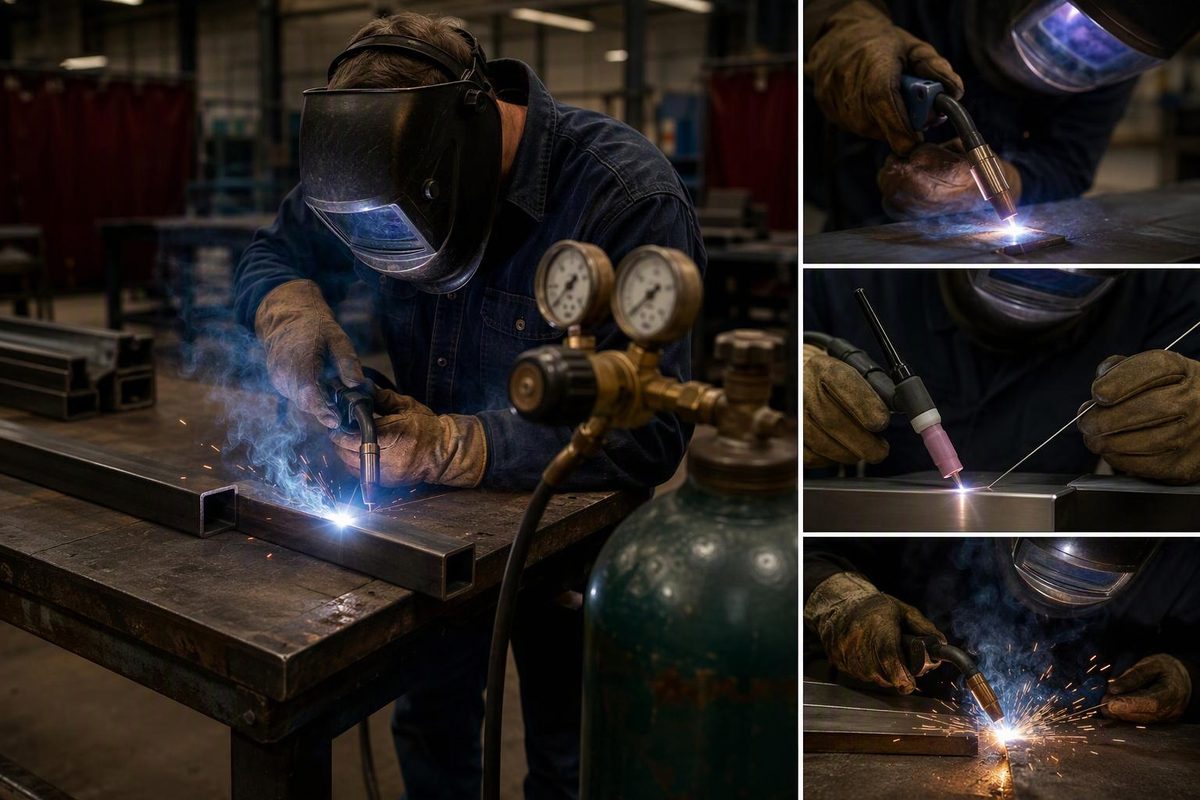
For common shop work, 75% argon/25% CO₂ is a familiar choice for short-circuit MIG welding mild steel; 100% argon is the usual starting choice for TIG and MIG aluminum. Neither is a universal welding gas. Stainless MIG, spray transfer and gas-shielded flux-cored wire require more specific matching.
First distinguish shielding gas from fuel gas. MIG and TIG use gas to protect the weld area from air; TIG shielding also protects the hot tungsten electrode. Oxy-fuel welding uses a burning gas—usually acetylene—with oxygen to produce heat. These are different systems, not interchangeable cylinder choices. OSHA’s welding fact sheet explains the process distinction; Miller’s TIG guide explains electrode protection.
Match the gas before adjusting settings
Shielding gas affects more than contamination. It changes arc stability, spatter, penetration profile and, in MIG, metal transfer. That means a gas change can require a settings change rather than simply producing a cleaner version of the same weld. See Miller’s MIG gas guide and its transfer-mode guidance.
Use this table to identify a likely option, then verify the consumable datasheet, machine program and any applicable welding procedure specification (WPS).
| Process and material | Common gas choice | Important limit |
|---|---|---|
| Short-circuit MIG, mild steel | 75% argon/25% CO₂, often called C25; pure CO₂ where permitted | CO₂ generally costs less but produces more spatter and a less stable arc. |
| Spray or pulsed-spray MIG, mild steel | An argon-rich blend, such as 90% argon/10% CO₂ | Do not assume the C25 short-circuit setup is suitable. Match the transfer mode and machine program. |
| MIG, aluminum | 100% argon; argon/helium for selected applications | Do not substitute a steel MIG blend containing CO₂. |
| MIG, stainless steel | A specified stainless blend | Traditional short-circuit setups may use 90% helium/7.5% argon/2.5% CO₂; other machines support different blends, including 98% argon/2% CO₂. |
| TIG, common steels, stainless and aluminum | 100% argon; argon/helium when the application requires more heat | A MIG argon/CO₂ blend is not a TIG substitute. |
The MIG examples come from Miller’s material-specific recommendations and pulsed-MIG guide. Its TIG shielding guide identifies argon as the best all-around choice and explains that adding helium increases heat input but can make arc starting less consistent.
For process-specific selection, see gas for MIG welding or gas for TIG welding.
Does flux-core need a cylinder?
FCAW-S is self-shielded; FCAW-G needs external shielding gas. Flux in a self-shielded wire generates its protection. Gas-shielded flux-cored wire still needs a cylinder despite producing slag. Verify the exact wire’s required gas rather than treating all tubular wire alike. Miller explains both variants; our flux-core welding definition covers the setup distinction.
Set flow—not just cylinder pressure
Gas pressure in the bottle does not tell you whether the weld pool has adequate coverage. Check the flow reading with gas actually flowing, using the machine’s purge function where available and following its manual.
For a sheltered setup, manufacturer examples include:
- Short-circuit MIG: 25–35 cubic feet per hour (CFH), approximately 12–17 L/min, in Miller’s MIG guidance.
- TIG: 15–20 CFH, approximately 7–9 L/min, in Miller’s troubleshooting guidance.
These are starting examples, not fixed settings. Cup or nozzle size, gas composition, current, joint access and air movement affect the requirement. Too little flow leaves the pool exposed; too much can create turbulence that draws air into the shielding stream. A larger regulator reading is not automatically better protection. Miller’s TIG shielding guide explains the flow mechanism; Bernard/Tregaskiss discusses nozzle design and current-related requirements.
Porosity with the gas on: check in this order
Stop and correct the cause rather than welding over suspect material.
- Confirm the gas and routing. Read the cylinder label and check the selected process. On a multiprocess machine, verify the hose is connected to the correct MIG or TIG inlet.
- Confirm delivery. Check flow while gas is running. Inspect hoses, fittings and the gun connection for damage or leakage. A torch-end flow checker can help distinguish regulator flow from actual delivery.
- Inspect the front end. Remove spatter blocking MIG nozzle or diffuser ports. For TIG, check cup, insulators, seals and torch assembly.
- Check coverage at the joint. Drafts and excessive nozzle-to-work distance can defeat an otherwise correct supply. Keep cooling fans from blowing across the pool.
- Check cleanliness. Oil, moisture, rust and other contamination can cause porosity even when shielding is adequate.
These checks draw on Miller’s MIG delivery guidance, its TIG coverage guidance, and Bernard/Tregaskiss’s porosity troubleshooting. A better-looking test bead helps evaluate a correction; it does not establish internal soundness or code acceptance.
Buy the right supply and handle it safely
Give the supplier the exact gas composition, not just “welding gas.” Confirm regulator compatibility, cylinder ownership or rental terms, exchange availability and stated gas capacity.
For planning, gas volume divided by flow gives theoretical gas-on time: an 80 ft³ fill at 25 CFH is 3.2 hours, assuming the full stated volume is available at that constant flow. Useful arc time will be shorter because purging, TIG pre-flow/post-flow, leaks and gas left in the cylinder also consume or reduce the available supply.
Secure cylinders against falling, protect their valves, use a cylinder cart, and use pressure-rated equipment compatible with the gas and connection. Princeton EHS’s cylinder guidance supports these handling precautions.
Argon, helium and CO₂ can displace oxygen and cause suffocation, particularly in enclosed or confined spaces. Do not shut off required ventilation to preserve shielding; correct drafts without removing exposure controls. Confined-space welding needs the applicable site controls, not merely an open door or a fan. OSHA’s fume and gas guidance addresses both ventilation and oxygen-displacement hazards.