
What Is Tungsten Inert Gas Welding? How TIG Works
Learn how TIG welding works, why its tungsten electrode differs from MIG wire, and what to check for shielding, polarity and common weld problems.
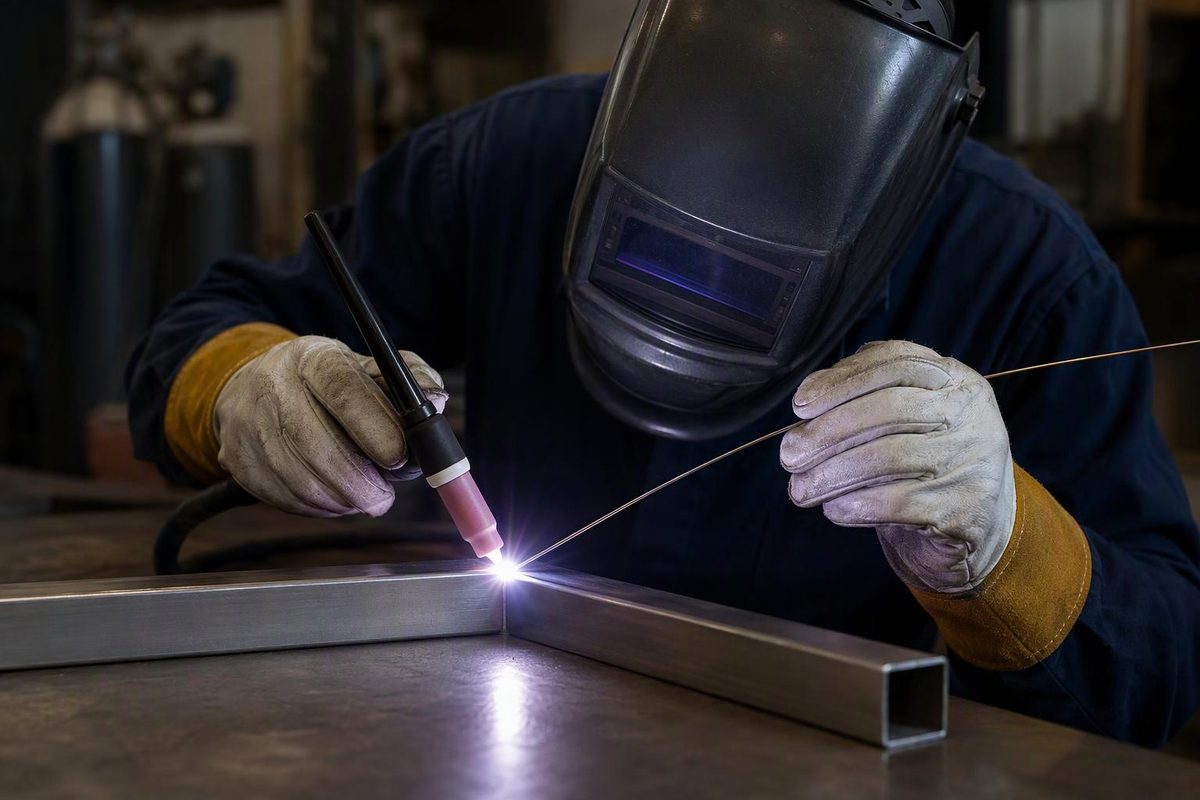
Tungsten inert gas welding—TIG, also called gas tungsten arc welding (GTAW)—uses an electric arc between a non-consumable tungsten electrode and the workpiece to melt metal at the joint. An externally supplied shielding gas protects the electrode and weld pool from the surrounding air. If the joint needs filler metal, it is added separately rather than supplied by the electrode. TWI’s process overview describes these defining features.
That separation of the arc from the filler is what gives TIG its distinctive control—and makes manual TIG more demanding to coordinate.
How TIG welding works
A TIG torch holds the tungsten electrode inside a gas cup. The electrode carries welding current; the cup directs shielding gas around the hot welding area. Argon is the most common gas, although helium and argon-helium mixtures also have applications. TWI explains these gas choices.
The basic sequence is:
- Establish the arc and form a weld pool. The arc melts the base metal at the joint. The shielding gas protects the heated material; it is not fuel for a flame.
- Add filler if required. In manual TIG, the welder feeds a separate rod into the pool while moving the torch. Suitable joints can be welded without filler, called autogenous welding.
- Advance the pool along the joint. Current, arc length, travel speed and filler addition together determine how the joint melts and fills.
The tungsten is described as non-consumable because it is not intended to melt into the weld. It can still erode or become contaminated and need attention. TWI explains electrode erosion and separate filler addition; Fronius describes the torch, gas protection and mechanized filler-feed options.
How is it different from MIG?
In MIG welding, continuously fed wire acts as both the electrode and filler metal. In TIG, the tungsten supplies the arc and the filler is separate. During manual TIG with filler, one hand normally holds the torch while the other feeds the rod; a foot pedal or torch-mounted control may adjust current. A pedal is common, not a defining requirement of the process. Miller’s TIG basics guide explains this arrangement.
For the job-selection trade-offs, see MIG welding vs. TIG welding.
What equipment and polarity does TIG need?
A typical setup includes a constant-current welding power source, TIG torch, correctly selected tungsten and torch consumables, work lead and clamp, shielding-gas cylinder and regulator/flowmeter, and suitable filler when required. Remote current control and torch cooling depend on the equipment and application. Miller’s setup guide shows typical system connections.
Polarity matters because it changes where heat is concentrated and whether the arc provides oxide-cleaning action:
| Common application | Usual TIG output | Practical reason |
|---|---|---|
| Carbon steel and stainless steel | DC electrode negative (DCEN) | Keeps the tungsten negative, limiting electrode heating |
| Aluminum | Alternating current (AC) | The electrode-positive portion provides oxide-cleaning action |
These are common configurations, not substitutes for a welding procedure. TWI’s power-source explanation covers constant-current operation and polarity effects. For conventional aluminum TIG, select equipment with AC capability rather than assuming a DC-only TIG machine will suit the job.
There is no useful universal amperage setting for “TIG welding.” Base metal, thickness, joint geometry, position, tungsten size and machine characteristics must come first. Follow the applicable procedure and equipment manual; use representative test pieces where appropriate. Our TIG welder guide covers equipment selection and setup in more detail.
Where TIG is useful—and where it is slower
TIG is particularly useful for thin material, controlled root passes and work where access to the weld pool and precise filler placement matter. Common materials include steel, stainless steel, aluminum and nickel alloys. It normally produces no flux slag and little to no spatter when operating correctly. Miller describes its material range and puddle control.
The limitation is productivity: conventional TIG is generally less attractive for depositing large volumes of weld metal. A pipe or heavy-section joint may use TIG for the root and a more productive process for subsequent passes. Mechanized cold-wire and hot-wire variants can improve deposition and travel speed. Fronius’s process overview explains these applications and variants.
Check the setup before changing current
Match the symptom to the first checks rather than treating every problem as an amperage issue:
- Arc will not start: Check the work connection, cable connections, selected process and starting mode. Verify gas flow at the torch.
- Tungsten burns back or melts: Check polarity, gas coverage, tungsten diameter and current. On AC, excessive electrode-positive time can overheat the tungsten. Miller’s basics guide covers starting problems and tungsten overheating.
- Porosity or contamination: Check the material preparation, shielding-gas supply, flow and drafts. More gas is not automatically better; excessive flow can also disrupt coverage.
- Poor fusion: Review joint fit-up, arc length and travel technique before simply increasing amperage. Miller’s troubleshooting guide identifies shielding and fusion problems.
A smooth bead does not establish internal fusion or certify the weld. Critical work needs the required procedure, qualification and inspection—not an appearance-based verdict.
Low spatter does not mean low hazard
TIG still exposes welders and nearby workers to arc radiation, burns and electrical hazards. Use appropriate eye, face, skin and hand protection, and follow the machine manual and site rules. OSHA’s welding hazard guidance identifies these risks.
Control fumes and gases even when little smoke is visible. Argon and helium can displace oxygen, especially in enclosed spaces; outdoor work alone does not guarantee adequate ventilation. Use appropriate ventilation and exposure controls, and do not treat an ordinary TIG setup as permission to weld in a confined space. OSHA’s welding fume and gas fact sheet explains these hazards.