
Choose a Hardfacing Electrode by Wear, Impact, and Base Metal
Use abrasion, impact, and base metal to compare documented SMAW options by hardness, amperage, polarity, welding position, and layer limits.
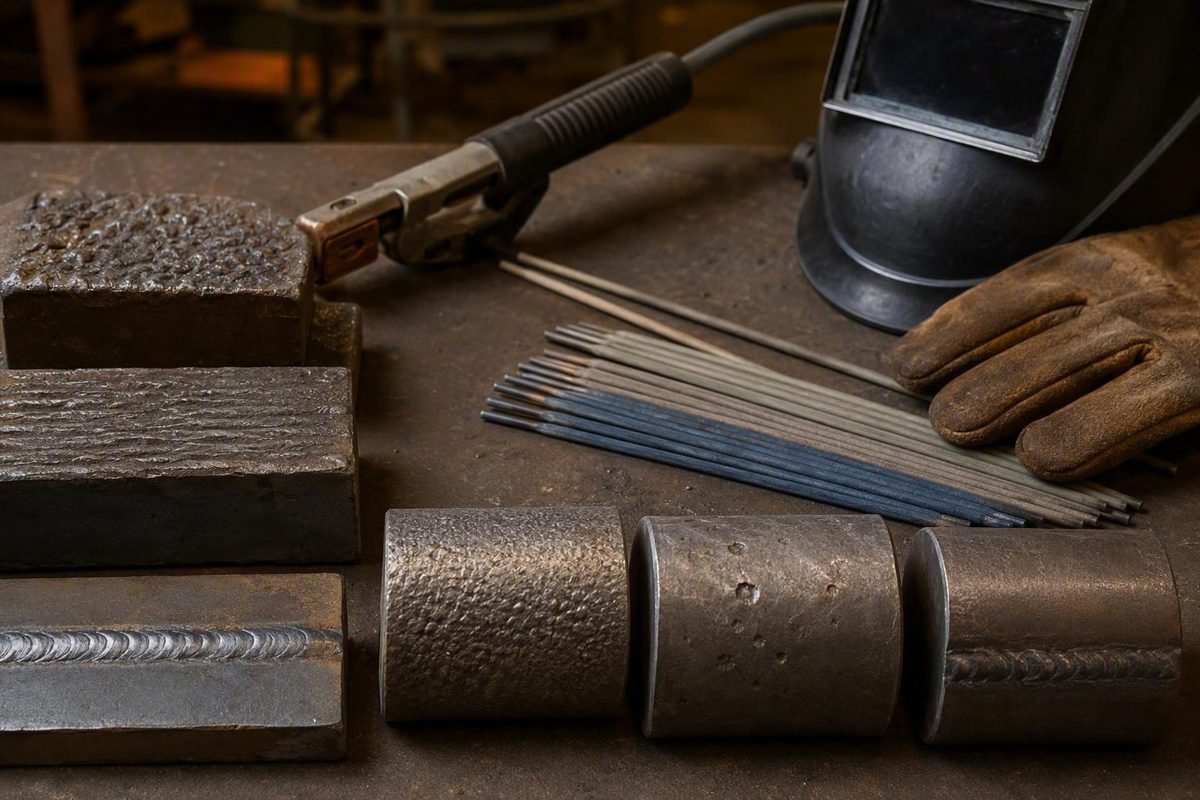
The best hard facing welding rod is the SMAW electrode matched to the part’s dominant wear mechanism—not necessarily the rod with the highest hardness. First determine whether the damage is mainly abrasion, severe impact, metal-to-metal contact, or metal-to-earth wear. Then identify the base metal and verify the required buildup thickness, welding position, operating temperature, finishing method, amperage, polarity, and heat-control limits before buying.
Quick-selection table: start with the wear mechanism
Use the observed failure pattern rather than the component name. Two bucket teeth may require different deposits if one cuts abrasive sand while the other repeatedly strikes large rock.
| Wear problem | Candidate direction | Controlling limit |
|---|---|---|
| Extreme abrasion; low–moderate impact | Wearshield 60 example | Flat/horizontal; two overlay layers |
| Severe impact | Work-hardening manganese, such as Mangjet | Base metal and heat control |
| Moderate abrasion; low impact | Forney Supercote example | Not a severe-impact recommendation |
| Metal-to-metal or high-temperature wear | Dedicated application alloy | Verify service-specific performance |
| Deeply worn part | Compatible buildup before final overlay | Restore dimensions within overlay limits |
| Cast iron, tool steel or unknown substrate | Obtain an exact repair procedure | Do not infer compatibility from hardness |
Wearshield 60 is positioned for extreme abrasion with low-to-moderate impact, including grader blades and crusher jaws. Mangjet takes a different approach: its austenitic manganese deposit is intended to work harden under severe impact and is listed for components such as hammers, dragline pins, crusher parts, and bucket teeth. These are documented examples, not universal recommendations.
Hardness alone cannot settle the choice. A very hard carbide-rich overlay may resist sliding mineral abrasion but be unsuitable for repeated heavy blows. A manganese deposit can begin relatively soft and become harder in service. Impact toughness, work hardening, substrate dilution, layer count, cracking behavior, service temperature, welding position, and required thickness all affect the result.
Metal-to-earth service also requires more detail than the label suggests. Fine abrasive soil, sharp rock, repeated impact, and sliding contact do not produce the same wear. Identify what is removing material and where it occurs before choosing an alloy family.
Treat metal-to-metal wear, buildup, elevated-temperature service, tool steel, and cast iron as separate selection problems. Manufacturer catalogs contain dedicated alloy families for these conditions, but a broad catalog description is not enough to prescribe a rod or welding procedure.
Confirm that the product is actually a hardfacing stick electrode
Hardfacing filler metal is used to restore worn parts or add a protective wear layer. In this guide, a “hardfacing welding rod” means a coated electrode applied by shielded metal arc welding, or SMAW.
Do not assume every product in a hardfacing category is a stick electrode. Manufacturer and retailer catalogs may combine:
- Coated SMAW electrodes
- Gas-shielded or self-shielded flux-cored wires
- Metal-cored wires
- TIG filler rods
- Oxy-fuel tubular rods
- Submerged-arc wire and flux
- Gouging or cutting electrodes
- Prefabricated wear plate
For example, Lincore 55-G is a hardfacing consumable for metal-to-metal wear and mild abrasion, but it is a gas-shielded wire supplied on spools or drums. Its shielding-gas and wire-feed requirements exclude it from a rod-only SMAW comparison.
Category placement is not proof of process. Even a page labeled for hardfacing electrodes can include wear plate, gouging rods, oxy-fuel products, or wire. For an SMAW product, look for an explicit “SMAW” or “stick” designation, coated-electrode dimensions, and stick-welding amperage and polarity.
Also distinguish buildup from overlay:
- A buildup electrode restores lost dimensions or creates a compatible foundation.
- A final hardfacing overlay provides the intended wear-resistant working surface.
Both are hardfacing-related consumables, but they perform different jobs and are not automatically interchangeable.
Compare three documented stick-electrode examples
These examples represent three different selection paths. Do not rank them without wear or service-life results produced under comparable test methods and conditions.
| Product | Typical hardness | Application limit |
|---|---|---|
| Wearshield 60 | HRC 57–60, one layer; 60–62, two | Abrasion with low–moderate impact; two-layer maximum |
| Wearshield Mangjet | HRC 18 as welded; 47 work-hardened, two layers | Severe impact; no vertical-down welding |
| Forney Supercote | HRC 52–58 | Moderate abrasion, low impact; 5/32-inch example: 115–160 A, AC or DC reverse |
Wearshield 60 is a carbide-style abrasion overlay. Its flat-or-horizontal restriction and two-layer maximum can rule it out even when its hardness appears attractive.
Mangjet illustrates why as-welded hardness can be misleading. Its deposit is intended to work harden in service, making it a different choice from a carbide-rich abrasion overlay. Its unlimited-layer statement is conditional on following the specified temperature and procedural controls.
Forney Supercote is the smaller-package moderate-duty example. Its stated application is moderate abrasion with low impact, so its specifications do not support treating it as a severe-impact electrode.
All listed hardness figures are typical manufacturer values, not guaranteed results for every repair. Deposited properties can change with substrate dilution, buildup alloy, layer count, test conditions, and in-service work hardening.
Match the electrode to the base metal and required thickness
Positively identify the substrate before selecting an electrode. Carbon steel, low-alloy steel, stainless steel, austenitic manganese steel, cast iron, high-carbon steel, and tool steel cannot be treated as one interchangeable group.
If the part is deeply worn, separate the repair into two functions:
- Restore the profile. Deposit a compatible buildup alloy until the part approaches its required dimensions.
- Add the wear surface. Apply the selected final overlay within its stated layer limit.
Wearshield 60 provides a clear example. Because the hard deposit is limited to two overlay layers, a repair requiring more restored thickness should first be built up with a manufacturer-specified compatible product. The final Wearshield 60 overlay must remain within its two-layer limit. Stacking additional hard layers is not a substitute for buildup.
Manganese-steel repair presents a different concern. Before applying Mangjet, remove work-hardened base metal and old work-hardened deposit. The manufacturer identifies those areas as more prone to embrittlement and possible cracking and recommends removing material that cannot be readily indented with a center punch.
Stop and obtain a current product-specific procedure when the part is cast iron, an unknown steel, high-carbon steel, or tool steel. Spark appearance, component type, or a seller’s broad compatibility statement is not enough to establish the required filler, preheat, interpass control, or cooling practice.
Manufacturer catalogs list specialized products for cast iron, manganese steel, tool steel, and other substrates. That positioning can help narrow the search, but it does not by itself establish a complete repair procedure.
Set up and apply the overlay within the rod’s limits
Before striking an arc:
- Identify the base metal and any existing deposit.
- Clean the repair area to sound metal.
- Remove contaminated, embrittled, unsuitable, or work-hardened material as required.
- Repair underlying cracks before covering the surface.
- Confirm the exact product and electrode diameter.
- Check polarity and amperage against the current product sheet.
- Confirm that the welding position is permitted.
- Establish whether a buildup layer is required.
- Determine the maximum permitted overlay layer count.
- Set any required preheat and interpass-temperature controls.
- Check the welding machine’s output, duty cycle, and electrode-size capability.
- Confirm how the finished deposit will be ground, machined, or otherwise brought to profile.
Wearshield 60 operating ranges
| Diameter | DC+ | AC |
|---|---|---|
| 1/8 in | 100–140 A | 110–150 A |
| 5/32 in | 130–180 A | 140–200 A |
| 3/16 in | 210–250 A | 230–270 A |
The Wearshield 60 specifications identify DC+ as preferred, restrict welding to flat or horizontal positions, and state that high-carbon or low-alloy steel may require preheat of 120–200°C (250–400°F) to reduce heat-affected-zone cracking. That preheat range is product- and substrate-specific, not a general rule for every steel.
Do not carry over settings from another electrode diameter or rely on an old package label when current documentation is available.
Wearshield Mangjet operating ranges
| Diameter | DC+ | AC |
|---|---|---|
| 5/32 in | 120–180 A | 125–210 A |
| 3/16 in | 160–260 A | 175–275 A |
| 1/4 in | 200–350 A | 225–375 A |
The Mangjet data sheet limits interpass temperature to 260°C (500°F) and recommends stringer beads or, at most, a slight weave to control heat buildup. Its unlimited-layer allowance applies only when the specified preheat, interpass-temperature, and procedural controls are maintained.
The cited Mangjet sheet is dated January 2012. It says preheat is generally unnecessary unless the work is below room temperature or unusually massive/complex; its stated exception is only to room temperature or at most 38–66°C (100–150°F). Confirm the current procedure for the supplied electrode.
This difference matters: some high-carbon or low-alloy steels may require product-specific preheat, while austenitic manganese steel must be protected from excessive heat. One generic preheat rule cannot safely cover both cases.
Wearshield 60 will usually cross-check. That manufacturer-identified deposit behavior should not be generalized to every hardfacing alloy or used to dismiss cracking into the base metal, separation, or detached pieces. Stop and reassess the repair if damage extends beyond the expected overlay pattern.
Use the current product sheet for the exact consumable, together with the welding-machine manual and the applicable site procedure. If those documents conflict with general guidance, follow the product, equipment, and workplace requirements.
Check finishing requirements before choosing a hard deposit
Decide how the part will reach its final dimensions before buying the electrode. A deposit unsuitable for conventional machining may still work when it can be applied close to profile or finished by an approved grinding method. It may be a poor choice for a shaft, sealing surface, or other component requiring close-tolerance machining.
Lincoln describes Wearshield 60 as non-machinable and non-forgeable. That limitation should not be generalized to carbide, manganese, martensitic, cobalt, nickel, or other hardfacing alloys.
Machinability, hot forgeability, grinding response, and heat-treatment response are alloy-specific. If the repair requires a finished diameter, tooth profile, cutting edge, sealing surface, or close tolerance, verify the permitted finishing method in current technical documentation before purchasing.
Buy by specification, not by the cheapest listing
Compare every candidate with the same purchasing checklist:
- Exact consumable format: SMAW stick rather than wire or oxy-fuel rod
- Intended wear mechanism and impact level
- Compatible base metal
- Electrode diameter and length
- Package weight and quantity
- Required amperage and available machine output
- AC or DC polarity
- Welding-position restrictions
- Maximum layer count
- Preheat and interpass requirements
- Machining, grinding, or forging limits
- Current technical data sheet and safety data sheet
Displayed package prices are not directly comparable unless currency, package weight, electrode diameter, quantity, shipping, taxes, and observation date are recorded. A one-pound package of 5/32-inch electrode and a ten-pound package of 1/8-inch electrode are not equivalent purchases, even if both are sold as hardfacing sticks.
Avoid calculating per-rod value from broad option ranges, “from” pricing, placeholder amounts, mixed currencies, or unclear stock records. Category pages can also combine multiple package variants and show conflicting availability labels.
Possible sourcing routes include manufacturer catalogs, established welding-supply retailers, and special orders through a local supplier. Ask for the exact product and size rather than simply requesting “hard facing rod.”
Retail reviews may help identify ordering or shipping problems, but they do not validate deposited hardness, wear life, impact resistance, or substrate compatibility. Category placement likewise does not establish technical suitability.
Total repair cost extends beyond package price. Account for surface preparation, crack removal, required buildup, deposition time, position accessibility, finishing, downtime, and whether the overlay can be applied within its layer and temperature limits.
Control fumes and follow product-specific safety documents
Some hardfacing products can generate fumes containing significant manganese or chromium. Manufacturer documentation may therefore require special ventilation or local exhaust; the Lincore 55-G safety warning, for example, directs users to product safety documentation because of chromium- and manganese-bearing fumes.
Before welding:
- Read the current safety data sheet and container instructions.
- Use welding PPE appropriate to arc radiation, hot metal, slag, and electrical hazards.
- Provide ventilation or local exhaust suitable for the specific consumable and work area.
- Follow the workplace’s exposure-control and respiratory-protection programs.
- Keep unprotected people outside the arc-radiation and fume zone.
- Follow the welding-machine manual and site-specific safety rules.
Do not assume ordinary shop ventilation is adequate for every manganese-, chromium-, nickel-, cobalt-, or tungsten-bearing consumable. The article cannot replace the product SDS, workplace hazard assessment, equipment instructions, or site procedure.
Does a hardfacing electrode need an AWS classification?
Not every cataloged hardfacing product states an AWS classification. The Hobart hardfacing catalog, for example, lists purpose-specific buildup and overlay products marked “No AWS Classification.”
The absence of a stated classification does not by itself prove that an electrode is defective or unsuitable. Select it according to documented compatibility with the substrate, wear mechanism, impact level, welding position, and required procedure rather than assuming classification status alone establishes fitness.